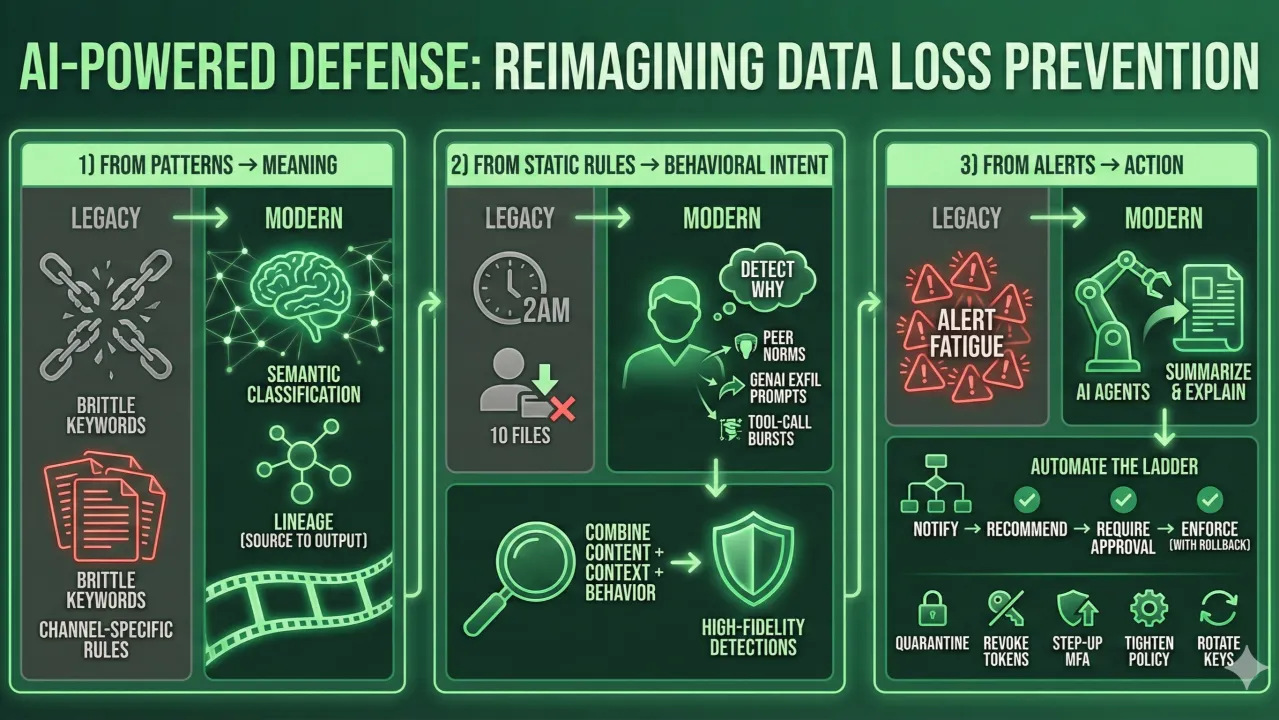
AI doesn’t just create new risks—it gives us the tools to finally make DLP effective: understand meaning, infer intent, capture lineage, and act with guardrails.
From regex to meaning
- Legacy: brittle keywords/regex, channel-specific rules, high noise.
- Modern: semantic classification (grasp concepts like roadmaps/algorithms), plus lineage that shows the movie of an incident from the source to output
From static rules to behavioral intent
- Move beyond “downloaded 10 files at 2am.”
- Detect why: access outside peer norms, prompts suggesting GenAI exfil, agent tool-call bursts.
- Combine content + context + behavior so signals become high-fidelity detections, not alert fatigue.
From alerts to action (Data SecOps copilot)
- AI agents pull artifacts, summarize, explain why it matters, and propose next steps.
- With guardrails, automate the ladder: notify → recommend → require approval → enforce (with rollback).
- Routine actions: quarantine links/files, revoke tokens, step-up MFA, tighten a policy, rotate keys.
Bottom line
DLP evolves from file rules to reasoning + lineage + controlled automation—protection that sits where work happens (prompts, retrieval, identity) and adapts as fast as the business.
Part 4: A Vision for the Future: The ‘Full-Self-Driving’ Data Security Platform, is on the way…