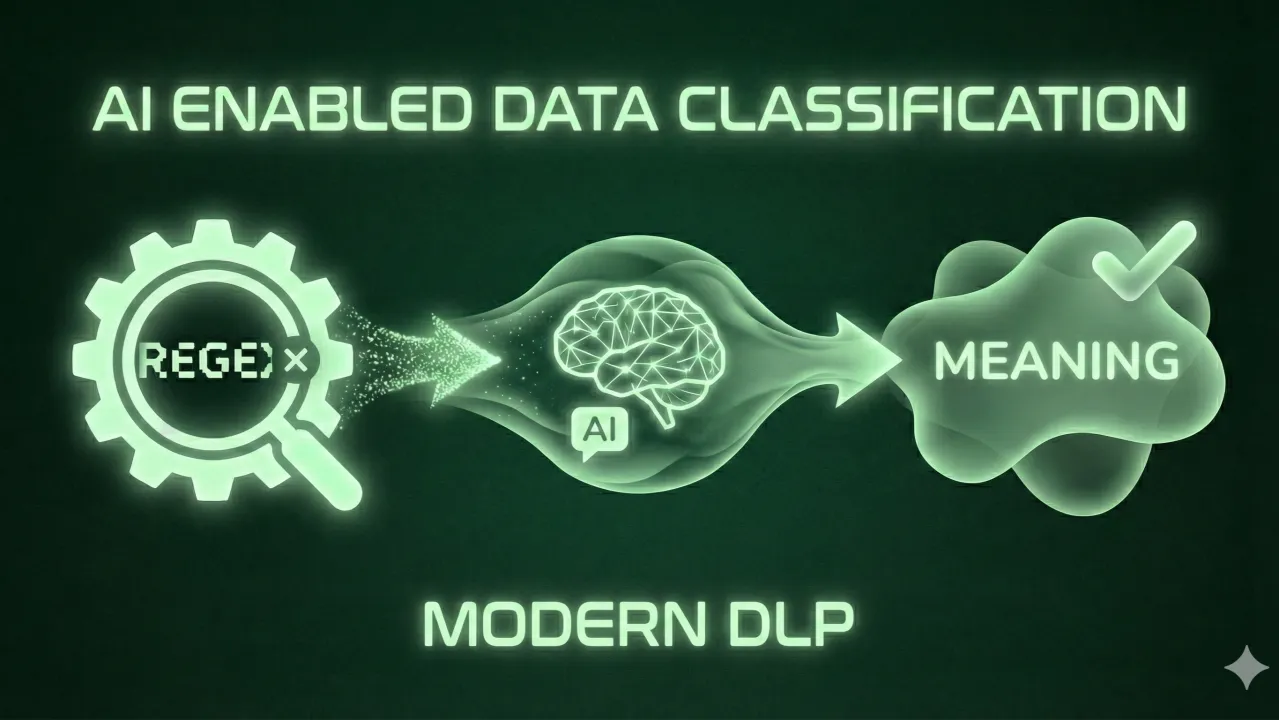
Modern DLP lives or dies on how well it classifies content. Keywords aren’t enough. Modern DLP has to understand content and act with confidence. Here are the six pillars (with tiny examples):
1. Pattern + validation foundation (the fast sieve)
Cut noise first: tolerant regex → Luhn/checksum → brand/IIN rules → negative filters.
Example: 5500 0000 0000 0004 passes Luhn ⇒ PCI PAN; INV-2025-…0004 looks similar ⇒ suppress.
2. Semantic concepts (catch meaning)
Label meaning/intent, not just words—roadmaps, pricing strategy, proprietary algos.
Example: “Quarterly priorities” is classified as a roadmap based on milestones/owners/timelines.
3. Business-ontology alignment (your crown-jewel map)
Teach the system your taxonomy and codenames so results are actionable.
Example: Mentions of Project Orion map to Engineering › Roadmap, not astronomy.
4. Code-aware classification (protect IP & secrets)
Use AST/context to understand code structures, not just strings.
Example: pricing_engine/optimizer.py ⇒ proprietary algorithm; a stray .pem ⇒ secret.
5. Multimodal & OCR (screenshots, scans, slides)
Sensitive content isn’t always plain text—or English.
Example: A Slack image showing “Name / SSN / DOB” ⇒ PII export → auto-mask or hold.
6. Explainable classification (trust & speed)
Require confidence bands, highlights, and a one-line rationale.
Example: M&A sensitive — highlights: “deal room,” “target valuation,” “transaction structure”.